
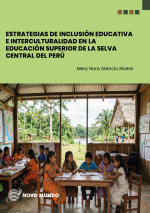
Strategies for educational inclusion and interculturality in higher education in the central jungle of Peru
Keywords:
Educational inclusion, Interculturality, Higher educationSynopsis
This work constitutes an exhaustive descriptive-documentary analysis and a robust political-pedagogical proposal aimed at transforming higher education in Peru through the synergistic articulation of educational inclusion and critical interculturality. Based on a rigorous socio-educational diagnosis of the Central Jungle—a region marked by high ethnolinguistic density and profound structural, geographic, and nutritional gaps—the text challenges "functional interculturality" and the symbolic violence of traditional Eurocentric monocultural models. Instead, and under the framework of national and international regulations, it conceptually grounds an "ecology of knowledges" inspired by the Epistemologies of the South. To facilitate this paradigm shift, the book proposes and discusses four strategic and institutional axes applicable to contemporary university management: the implementation of active intercultural pedagogy in teacher training; the incorporation and equalization of the prestige of Indigenous languages in the core curriculum; the establishment of personalized tutoring with an equity and intersectional approach to mitigate dropout rates; and the critical use of ICTs adapted to the rural Amazonian reality. Finally, the document concludes with guidelines and recommendations for regional public policy aimed at institutionalizing a community-based, inclusive, sustainable, and reciprocal university governance system capable of restoring epistemic dignity to the Amazonian and Andean peoples of the country.


 Cdla Los Esteros Mz 5 A Villa 22, Guayaquil, Ecuador
 contacto@editorialnovomundo.com